

Principles of Marching Band Show Design - a Senior Project Interview
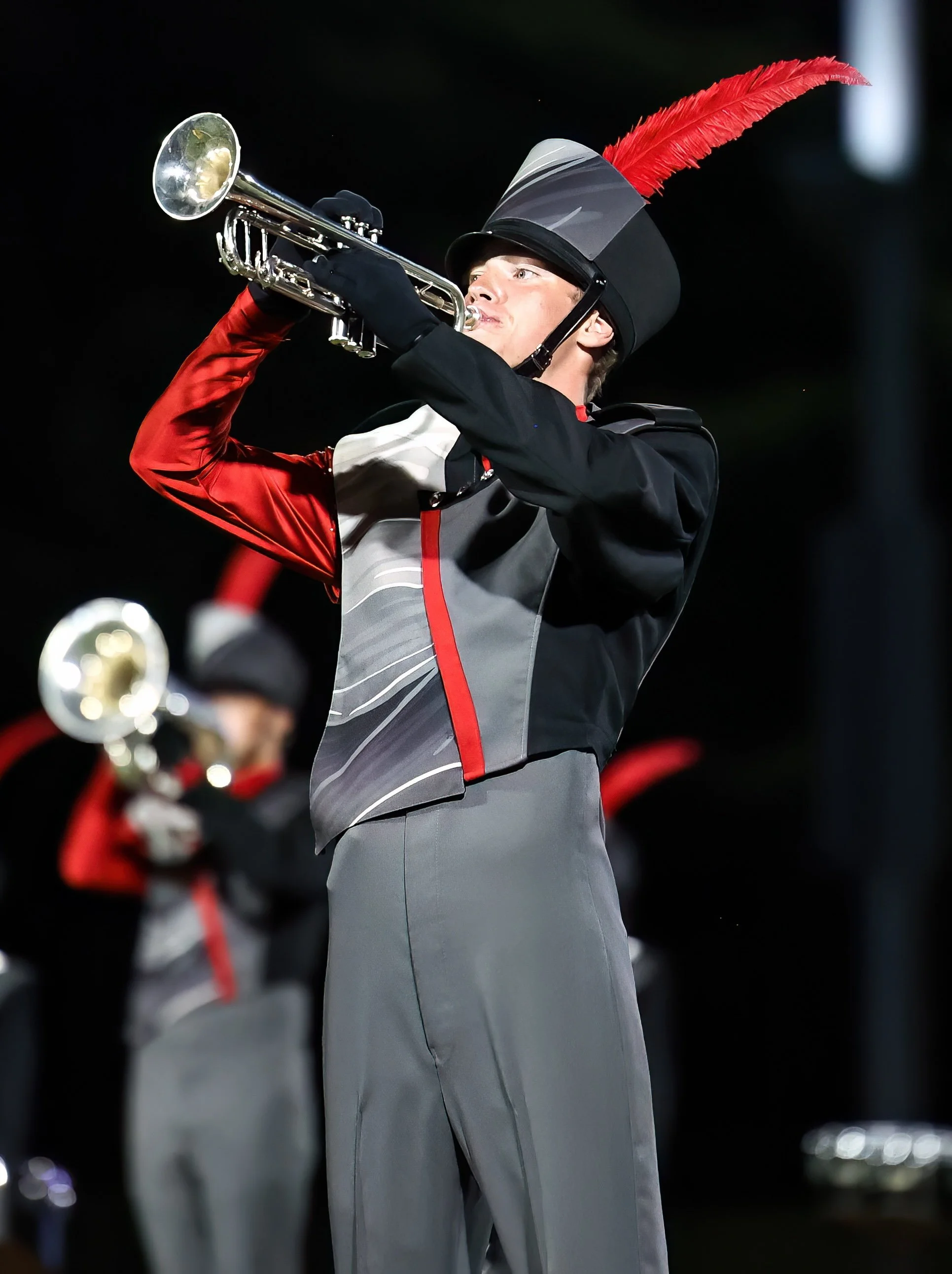
Shane Momchilovich of the Class of 2026, Baldwin-Woodville High School, Wisconsin.
I was honored to take part in this senior project of Shane Momchilovich, a class of 2026 trumpet performer at Baldwin-Woodville High School in west-central Wisconsin. Shane is interested in a career in marching band show design and arranging, and his questions were very insightful. I hope you enjoy the interview, and I wish all my best to Shane in his future musical career endeavors!
SHANE: How does the design hierarchy work? Does the brass writing influence the overall concept of the show, or is it the other way around? Does the concept dictate the writing?
DR. MILLER: This is a question that has many answers. It’s important to remember that the overriding caption that controls so much of a show’s success is "General Effect” - how well do all the sounds and sights coordinate and work together, with good pacing, clear audience focus, and variety, to produce a sustained and varied emotional response in the audience. Some show concepts and design teams start with the visual storyboard first. Other productions need to lean on sound design in the electronics first. I find that amongst the 20+ design teams I work with, about 80% of the time the winds are the first thing that gets written, followed by everything else. But I also have design teams where a percussionist sketches everything, and then I orchestrate it. In the end, the choice on “what comes first” comes down to “what does this show concept dictate for our process” and “which designer has the clearest idea of what this should look, feel, and sound like.” Leaving your ego at the door and allowing that flexibility is key.
SHANE: What is most unique about writing for a marching band, that makes it different from writing for a concert band or other sitting ensemble?
DR. MILLER: Marching Band writing is unique in its scale (literally, the size of the field canvas on which you’re designing and the large crowds and spaces entailed) paired with the need to balance artistic merit with practical idiomatic writing. We have to constantly be asking ourselves “does the physical and mental demand of this moment match the ability level of this ensemble, and is the risk of this demand properly pay off in the audience and judge appreciation for what we’re doing?” Remember, judges only give you credit for what you achieve, not what you try to achieve. So writing within the capabilities of the ensemble, be it range, sustained volume, technique limitations, field spread, or just plain mental and physical stamina, are a must. You can’t just write whatever you want because it looks and sounds cool. The performers must achieve it at a high level. If this was pure art, there wouldn't be an Indianapolis Colts logo on the field while we do it. Always remember that balance.
SHANE: Do you write music primarily to impact the audience, or to be competitive for a judge? How do you balance the two?
DR. MILLER: I think this depends on your ensemble’s situation. If you’re writing for a marching band that relies on Friday night football crowds’ support, you’d better make sure that your show appeals to them while still satisfying the needs of a competitive, caption-based show. And in the end, I think it’s quite rare that any ensemble can ignore satisfying their Friday night crowds with relatable, recognizable musical and thematic content. It doesn’t mean you can’t explore more esoteric or darker materials ever. But there are limits. Do you think that a small town, rural audience on Friday night wants to hear a guard member screaming in a blood-curdling voice “Oh god no” as the final sound in a halftime show that explores mental illness and loneliness? (That’s a real high school show I saw once). I would posit that they do not. I’m not belittling that topic in any way, simply stating that there are more nuanced and receptive zones in which to explore those kind of darker, intense ideas. Like in all things, seek the middle way, where you balance audience comprehensive and reception with the more layered themes and meanings you want your production to explore.
SHANE: How do you determine the pacing of your show? Like deciding when to have full ensemble impacts vs section features vs solos?
DR. MILLER: There is no magic formula here. I will just say that your ensembles can’t sustain loud forever from a physical standpoint, and too long of a phrase that is softer/gentler gets boring. My suggestion? Watch the shows of bands you want to emulate from a competitive standpoint. Break out the stopwatch and map out the length and variety of their phrase structure, and then utilize that in your own work. That has been my process, and I feel like it really grew me as a writer and designer.
SHANE: Describe your creative process when writing the music. Do you think about harmonics and chords first, rhythms first, textures, or what else?
DR. MILLER: I don’t know whether my process is very much different or the same from the majority of writers. But for me, I sort of think of it all at once. I don’t map out shows beyond a storyboard for effect moments and a repertoire list. From there, I just cogitate at the computer and try to make it happen. Sometimes, I wake up in the middle of the night and some interesting chord progression or mellophone counterline has popped into my brain, and I go to another room and quietly sing it into my voice recorder app, or write it in a note. That wy, I have it at my fingertips when I sit down to write that section of the music. I will just way that, whatever your process, be it convergent or divergent (like my own), you make notes and plans, and keep refining what you’ve written by stepping away from it for a day or two, then coming back to it. Our brains continue to process many things in the background when we give them a rest, and often a better or clearer answer to a design or writing question becomes clear given that space and time.
SHANE: When you design a show, do you think of a long-form design and how to develop the whole show and its concepts first? Or do you think about smaller moments or features of the show you want to write first?
DR. MILLER: I would say that I move from big picture to smaller picture. Long-form, overall arc and narrative comes first, and then I work to telescope in and create opportunities for moments in the show that draw applause in a variety of moods and methods. That being said, there are often smaller-scale ideas that are part of the production plan from the beginning. This usually takes the form of a particular prop that we want to employ, or a soloist we know is very strong and want to feature.
SHANE: What makes you unique as a composer? What sort of tools or motifs do you write into your music often that give it your unique signature?
DR. MILLER: I really wish I had an answer to this. I don’t think composers and arrangers are always best at analyzing their own work, as they are too close to the source material and process. I know and recognize that I have several harmonic and textural gestures that I utilize often, but that’s simply because I know they work from both a functional and idiomatic standpoint. But I also hope that I can write 20+ shows in a year, and there won't be 20 judging panels saying “yep, that sounds like Ward Miller’s writing.” Is that the case? Who knows. But I work hard to continuously push myself to find new harmonies, progressions, textures, and effects. I would say that if there’s one thing that distinguishes my writing, I’d guess that it’s my harmonic language and voicing paired with motivic quotation and development.
SHANE: How much does the music change throughout the season, and what prompts you to make revisions?
DR. MILLER: The music changes whenever either I, the directors, or the judges just state that it’s not working from a pacing, impact, or clarity standpoint. That doesn’t mean that we just change course every time we are told by one judge that it’s not working. Sometimes we know that as the ensemble becomes more fluent and achieves what’s written, or as more judges get repeat viewings of the show, the intent will become clear. But if the ensemble is simply not achieving something from a technical standpoint, and they’ve had plenty of time to make it happen, I will push to water down the demand in order to make it achievable. I want to stress again - Judges do not reward what you’re trying to do, only what you actually achieve.
SHANE: How much of your job consists of adapting existing music for the marching band vs writing original music?
DR. MILLER: I would estimate that 85+% of my shows involve arranging existing music. Any composition I do is either to provide “soundalike,” royalty-free music for an ensemble, or because we need transitional or connective music that is not based on any particular work.
SHANE: When arranging existing music, whats the most common thing that needs to be changed "to make it work" for the band?
Dr. Miller: There’s no one thing that needs to be changed. But it’s just important that we always be writing idiomatically for band. It doesn’t matter if the source work is in G major; G major is a hard key for bands to play in with a good sound in tune, so we put it in a key that works for band. Audiences and judges don’t care about key signatures (though they certainly want a variety of key centers and harmonic topographies to be displayed), they care about bands looking and sounding good. Just because the original tune had fast pulsing 8th notes the entire time doesn’t mean we need that in the band arrangement. All of that tonguing is counterproductive to clarity and execution by wind players, so we adapt it, again to be more idiomatically appropriate to the band. Also, copying the original tune exactly isn’t effective either. An original tune by a pop artist has lyrics, a music video, laser lighting, reverb, scantily clad models, and all of the emotional connections to that artist that the audience brings from social media and more. We don’t have all of that. So you need other ways to bring excitement to the work. Livelier tempos. Interesting counter lines. Variety of texture. Visual coordination. So make sure that the original work is there and recognizable, but make it idiomatically work for the band ensemble.
SHANE: What advice would you give to a student trying to compose their first piece, intended to imitate a brass piece for the marching arts. What should they prioritize?
DR. MILLER: I believe that modeling your first arranging efforts on someone else’s work, work that you find effective and compelling, is the best way to start. Try to recreate some of the sounds you hear from them harmonically, texturally, and from a phrase pacing standpoint. Also, I want to leave you with this quote from Igor Stravinsky, because I always find myself coming back to it: "The more constraints one imposes, the more one frees one's self. And the arbitrariness of the constraint serves only to obtain precision of execution.” Paraphrased, this means that placing boundaries and limits on what you write will lead to you doing a better job. Writing for marching bands is about utilization of limited resources. We only have so many people who can play, so loud, so clear, so fast, for so long within a certain range on their instrument, while doing so much physically demanding coordinated drill, bodywork, and characterization. The sooner you force yourself to write within those kinds of restraints, the faster you’ll be stepping into the world of a professional writer. So start small. Limit yourself to 1.5 minutes max, for a smaller, younger ensemble. Look at some medium-easy to medium marching band arrangements. What instrument range limitations do they impose? At what ceiling of technical demand do they stop? Extract the metadata about phrase lengths, harmony, range, technique, texture, and more from those example works, and then apply them to your own. And then, finally, accept that getting feedback from mentors and from your fellow musicians is key. No one writes a perfect piece, especially not at first. If I could teleport back in time and meet my younger writing self just 15 years ago, I’d shake my head and tell me “you’re doing this wrong.” And use the resources of your friends. Write the piece, show it to your director, show it to a mentor, but also show it to your friends who play instruments that you don’t. Your clarinet friends are going to tell you “don’t write the 16th note run where we pass quickly from A# to B in the middle of the staff.” Your trombone friends are going to tell you “don’t write this slur from F to Gb,” and your saxophone friends are going to highlight for you the pitfalls of C# on their instrument. Every instrument has idiomatic quirks that you won’t be aware of until someone who plays it lets you know. Accept that to learn to ski, a lot of people have to watch you fall down, and the quicker you become okay with it and have a sense of humor about it, the quicker you’ll get where you want to go.
Thanks again to Shane Momchilovich for making me a part of this impressive senior project. And thanks for visiting my site! Please feel free to browse all of the music, articles, and more I have to offer here.
